
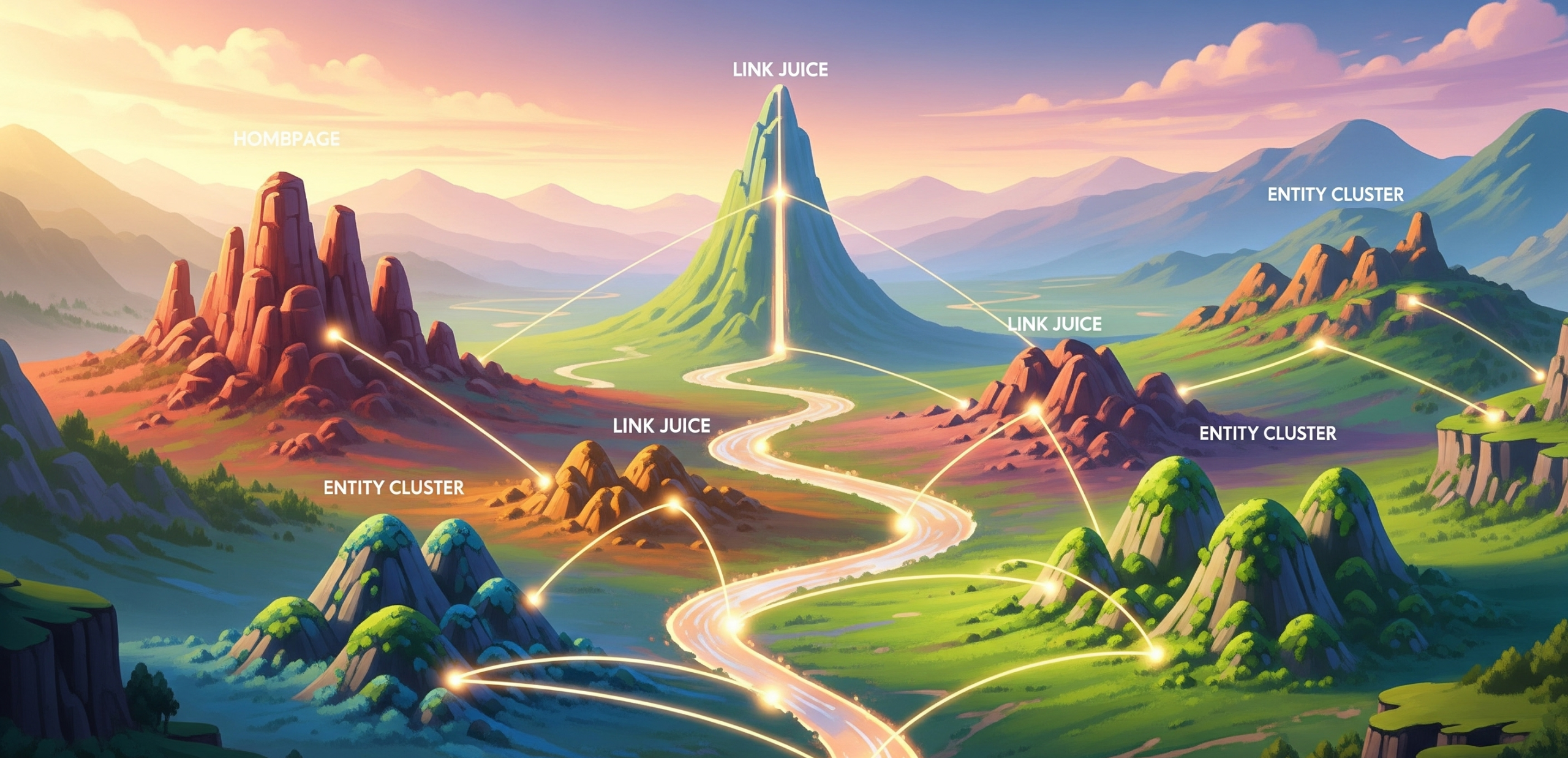
Why Internal Linking Still Matters
Internal linking has always been a cornerstone of SEO. Traditionally, it was seen as a way to distribute “link juice,” ensuring that authority flowed from one page to another.
But in 2025, the role of internal links goes beyond passing PageRank. Today, search engines—and AI-driven search models—use internal links to map relationships between topics, entities, and user intent.
Simply Put: Your internal linking strategy now defines how Google understands your content clusters and how AI assistants interpret your authority on a subject.
The Shift From Link Juice to Entity Clusters
Google’s algorithms have evolved from keyword-matching to entity recognition. Entities are people, places, things, or concepts that help search engines contextualize your content.
Internal links are no longer just pathways—they are signals that show how different entities on your site are connected.
By grouping related content into entity clusters, you send stronger topical authority signals. Instead of random cross-links, you’re building a semantic network of knowledge that AI-driven search engines can read and trust.
Benefits of Entity-Based Internal Linking
- Improved Indexing: Search engines crawl more efficiently when related pages are well-connected.
- Stronger Topical Authority: Clusters help establish you as an expert on a subject area.
- Enhanced User Experience: Visitors can easily navigate between related topics, increasing session duration.
- AI Search Readiness: Internal links provide semantic context that helps LLM-powered search engines interpret your content.
How to Build Effective Internal Linking Structures
1. Identify Core Topics (Pillars)
Start by mapping out the main themes of your site. These will serve as pillar pages—comprehensive resources that cover a broad entity (e.g., “SEO Basics” or “E-commerce Security”).
2. Create Supporting Content (Clusters)
Build supporting articles around each pillar. Each cluster page should target a specific sub-entity or question (e.g., “Internal Linking Best Practices” under the broader “SEO Basics”).
3. Use Descriptive Anchor Text
Gone are the days of generic “click here.” Anchor text should reflect the entity or topic of the linked page. For example:
“Learn more about semantic SEO” is more powerful than “read more.”
4. Maintain a Logical Hierarchy
Organize your internal links so that clusters clearly point back to their pillars, and pillars connect to related clusters. This hierarchy mirrors how entities connect in Google’s Knowledge Graph.
5. Balance Crawl Depth
Aim to keep important content within 3 clicks from your homepage. This ensures efficient crawling and reinforces entity connections without overwhelming users.
Common Mistakes to Avoid
- Over-linking: Too many links dilute value and confuse both users and search engines.
- Irrelevant Connections: Linking unrelated entities sends mixed signals.
- Neglecting Orphan Pages: Pages without internal links lose visibility and authority.
- Generic Anchors: Weak anchor text fails to communicate semantic relevance.
Internal Linking and AI-Driven Search
As AI-powered search assistants like ChatGPT, Perplexity, and Google SGE become more prominent, internal linking takes on a new role. These systems rely on semantic connections rather than just backlinks. By designing an entity-based linking strategy, you increase the chances that AI will surface your content as authoritative context.
Think of your website as a knowledge graph: every link is a connection in that graph, shaping how both humans and machines understand your expertise.
Actionable Checklist for 2025
- ✔ Define pillar pages and supporting content clusters.
- ✔ Use entity-rich anchor text in every internal link.
- ✔ Audit your site for orphan pages and link them appropriately.
- ✔ Keep crawl depth shallow for key resources.
- ✔ Review internal links quarterly to align with evolving content.
