
Most AI projects don’t fail on the model. They fail on the org chart. A team hires two machine learning engineers, ships a prototype in six weeks, and then stalls for six months because nobody owns data pipelines, nobody monitors the model in production, and nobody can say what it costs to run. The roles that make AI products ship, not just demos, rarely exist until the first outage forces the issue.
This piece lays out the roles an AI product actually needs, what each one costs to employ in the US market in 2026, and how to sequence hiring against a limited budget, so you build a team that ships rather than one that only prototypes.
The Core Roles, in the Order You Need Them
- Data engineer hire first, always:
Owns the pipelines that get data into a usable, trustworthy state: ingestion, cleaning, feature storage, and the plumbing between source systems and whatever the model touches. Without this role, model engineers spend most of their time hand-wrangling CSVs instead of building anything. Most teams skip this hire and regret it inside three months. - ML/AI engineer the person who builds and trains the model:
Distinct from a data scientist. A data scientist explores and proves an idea works; an ML engineer turns that idea into something that runs reliably at scale, with reproducible training runs and versioned models. For a first product, one strong generalist in this role beats two specialists. - MLOps/platform engineer hire once something is in production, not before:
Handles deployment, monitoring, retraining triggers, and rollback. A reasonable signal for when to add this role: once you have more than one model running live, or once a failure would cost you a paying customer rather than just an awkward demo. - Product manager with technical fluency not a generalist PM:
AI products fail differently from normal software: a model can be “working” and still be wrong in ways that erode trust slowly. A PM who can read an evaluation report and push back on a flawed metric is worth more here than one who manages a roadmap well but takes the engineering team’s word for model quality. - Domain expert or subject-matter reviewer often underpriced, rarely optional:
For AI products in regulated or high-stakes domains such as lending, healthcare, or hiring, someone has to validate that outputs are not just statistically sound but substantively correct which is the same gap a structured AI governance and compliance review is built to close before a model ever reaches production. This role is frequently brought in as a contractor billed by the hour or project rather than hired full-time, which hides its true cost from the team’s headcount budget.
A five- or six-person version of this team: one data engineer, one or two ML engineers, one part-time MLOps hire, one PM, and a domain reviewer brought in as needed is enough to take most AI products from prototype to production. Firms that build AI systems for regulated industries, including Samta.ai, structure teams this way deliberately: the data and governance roles come before the headline-grabbing ML hire, not after.
Skipping that ordering is the single most common mistake. Teams hire two ML engineers on day one, ship a demo that impresses in a meeting, and then discover nobody can explain why the model’s accuracy dropped after the fourth data source was added.
What Each Role Costs in 2026
These are US base-salary ranges for 2026, cross-checked across multiple compensation trackers: Glassdoor, ZipRecruiter, PayScale, and Levels.fyi. These sites rely on self-reported pay and job-posting data rather than payroll records, so treat the ranges below as directional planning estimates, not precise figures. Actual pay varies by city, company stage, and whether the number includes equity or bonus.
|
Role |
Mid-level base | Senior base |
Notes |
| Data engineer | 120,000–150,000 | 150,000–195,000+ | Senior roles at large tech firms can exceed $250,000 total comp |
| ML engineer | 160,000–195,000 | 190,000–245,000+ | Among the highest-paid roles on the team; total comp with equity often runs well above base |
| MLOps engineer | 130,000–165,000 | 180,000–240,000+ | Wide range because the title covers three different sub-roles: ML platform, ML infrastructure, and applied MLOps |
| Technical/AI product manager | 160,000–195,000 | 185,000–240,000+ | AI-specialist PMs typically earn 15–20% more than generalist PMs |
| Domain expert/reviewer | Varies widely by field | Varies widely by field | Usually contracted hourly or per project rather than salaried; budget separately from headcount |
A fully loaded five-person core team (one data engineer, one ML engineer, one part-time MLOps hire at roughly half-time, and one technical PM), excluding the contracted domain reviewer, runs roughly $550,000 to $700,000 a year in base salary alone in the US market, before benefits, payroll tax, and equipment, which typically add another 20–30% on top. Hiring the same roles outside the US, or through firms with distributed teams, commonly cuts that figure by 30–50%, though the trade-offs in time zone overlap and domain context should be weighed, not assumed away.
Sequencing Hires Against Budget
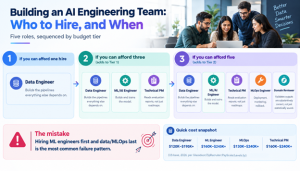
If you can only afford one hire: a data engineer. A working pipeline with no model is more valuable than a working model with no pipeline, because the pipeline is reusable for the next three ideas and the model usually isn’t.
If you can afford three: data engineer, ML engineer, technical PM. This is the minimum team that can both build something and tell you honestly whether it’s any good.
If you can afford five: add MLOps and a part-time or contracted domain reviewer. This is the point where “it works on my machine” stops being an acceptable answer.
The Mistake That Costs the Most Later
Teams treat MLOps and domain review as nice-to-haves, added once something breaks. Both are cheaper to build in from the start than to retrofit, for the same reason it’s cheaper to design a building with plumbing than to cut into finished walls later. A model that silently degrades for three weeks before anyone notices costs more than the salary of the person who would have caught it on day two.
Frequently Asked Questions
What’s the first AI engineering hire a small team should make?
A data engineer, not an ML engineer. A working data pipeline is reusable across every future AI idea; a trained model built on messy, unreliable data usually isn’t.
How is an ML engineer different from a data scientist?
A data scientist explores data and proves an idea works. An ML engineer takes that proof and builds something that runs reliably at scale, with reproducible training runs and versioned models. Many early-stage teams need the data scientist skillset for a few weeks and the ML engineer skillset for the rest of the product’s life.
When should a startup hire an MLOps engineer?
Once more than one model is running in production, or once a model failure would cost a paying customer rather than just embarrass a demo. Hiring MLOps too early means paying for monitoring infrastructure nothing depends on yet; hiring too late means the first real outage happens with no one responsible for catching it.
Do AI products really need a domain expert, or is that optional?
For lending, healthcare, hiring, or any regulated or high-stakes domain, it’s not optional. A model can be statistically accurate and still wrong in ways only someone who knows the domain will catch. Most teams contract this role hourly rather than hire full-time, which is reasonable, but it still needs a line in the budget.
What does a minimum viable AI team cost in the US in 2026?
Roughly $550,000 to $700,000 a year in base salary for a four-person core team (data engineer, ML engineer, part-time MLOps, technical PM), before benefits and overhead add another 20–30%.
Is it cheaper to build this team outside the US?
Often, by 30–50% for the same roles, through distributed hiring. The trade-off is less real-time overlap with your core team and sometimes a steeper ramp-up on domain context, so the savings aren’t free.
About the author: Rashi Lachuriya works in marketing at Samta.ai, an enterprise AI consulting firm helping regulated industries deploy governed, production-ready AI systems. She writes about AI strategy, governance, and adoption trends.
