
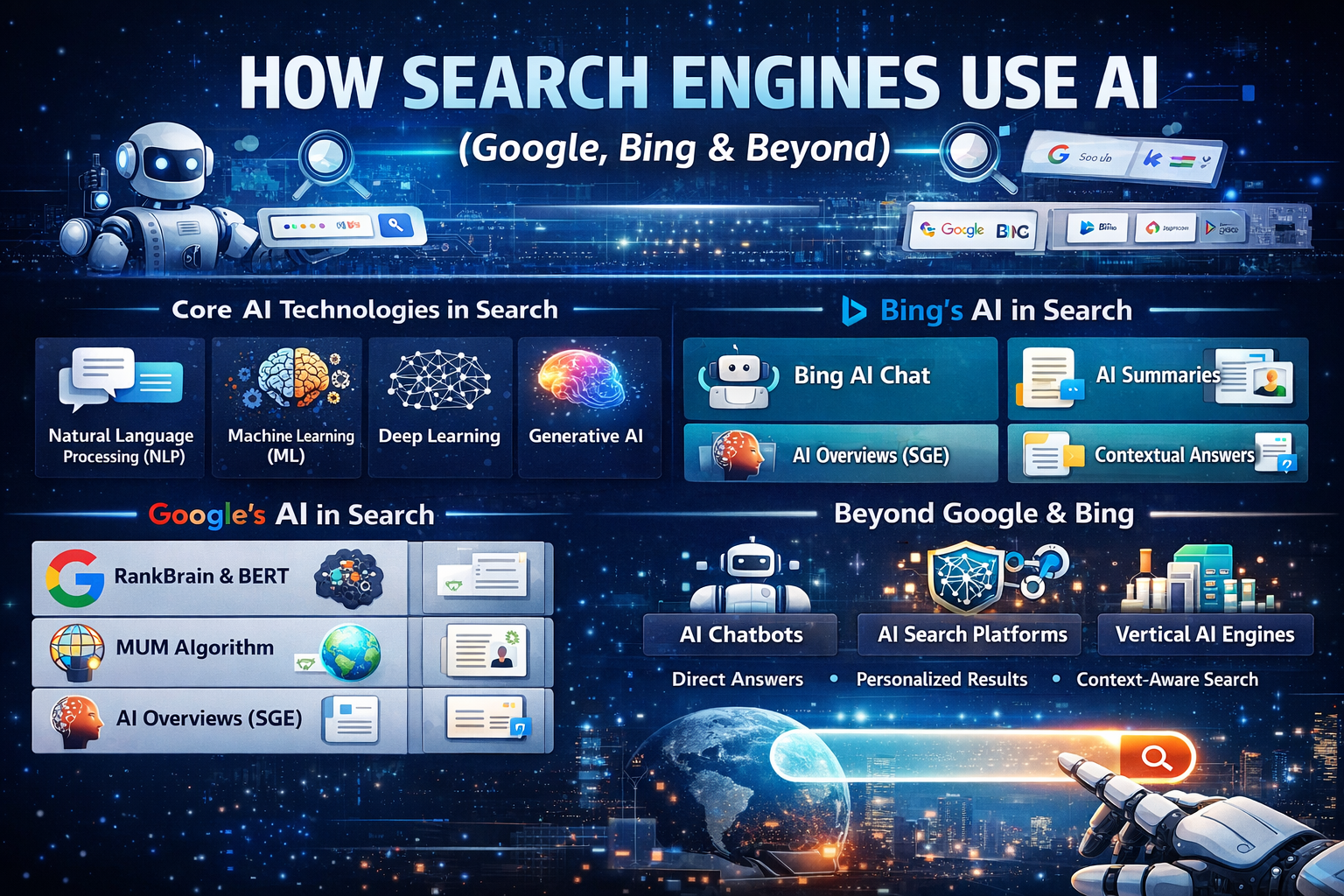
“Remember the last time you typed a half-formed question into Google and somehow got exactly the answer you needed? That’s not magic – it’s machine learning working quietly in the background, reshaping how we discover information every single day.”
Why Search Engines Needed AI in the First Place
Early search engines were essentially librarians with terrible reading comprehension. You typed “best running shoes for flat feet,” and they’d hunt for pages containing those exact words – nothing more, nothing less.
The problem? Human language is messy. We abbreviate, imply, and assume context. A keyword-match system couldn’t understand that “how do I fix my sink” and “DIY plumbing repair” are the same intent. AI changed that entirely.
Google’s AI Ecosystem: Layers Upon Layers
Google didn’t adopt one AI system – it built an entire stack of them, each solving a different problem.
| Google AI System | Introduced | What It Does |
|---|---|---|
| RankBrain | 2015 | Interprets ambiguous or never-seen-before queries using machine learning |
| BERT | 2019 | Understands the relationship between words in a sentence (context) |
| MUM (Multitask Unified Model) | 2021 | Processes text, images, and multiple languages simultaneously |
| Google SGE / AI Overviews | 2023–Present | Generates direct AI-written summaries at the top of search results |
RankBrain was Google’s first public admission that AI was core to ranking. Before it, engineers manually wrote rules for how to interpret queries. RankBrain let the system learn from real user behavior – what people clicked, how long they stayed, whether they came back to search again.
BERT was a genuine leap. It read sentences the way humans do – bidirectionally, picking up on words like “not” or “without” that completely flip a query’s meaning. “Flights from London to New York” and “flights to London from New York” finally meant different things to Google.
MUM went further still. Where BERT handled one task in one language, MUM can answer complex, multi-step questions by drawing from content in 75 languages and processing images alongside text. Ask it “I’ve hiked Mt. Adams, what should I prepare differently for Mt. Fuji?” – and it genuinely understands the comparison you’re making.
Bing and Microsoft: The Bold Challenger
While Google iterated quietly, Microsoft made headlines by embedding OpenAI’s GPT-4 directly into Bing in early 2023. It was a calculated gamble – and it worked.
| Feature | Google AI Overviews | Bing Copilot (AI Chat) |
|---|---|---|
| Underlying Model | Google Gemini | OpenAI GPT-4 |
| Response Style | Snippet-style summaries | Conversational, multi-turn chat |
| Source Citations | Partial | More explicit inline citations |
| Image Understanding | Yes (MUM/Gemini) | Yes (GPT-4 Vision) |
| Market Share (2024) | 91% | 3.4% |
The difference in philosophy is worth noting. Google tries to answer your query and send you on your way. Bing’s Copilot mode encourages a conversation – follow-up questions, refinements, and longer sessions. For users who want to research deeply rather than just get a quick answer, Bing’s approach often feels more satisfying.
I tried both tools while researching a complex medical question recently. Bing gave me a back-and-forth dialogue that helped me narrow down exactly what I needed to ask my doctor. Google gave me a cleaner, faster summary. Neither is objectively better – they serve different search behaviours.
Beyond the Big Two: AI in Other Search Platforms
Google and Bing aren’t the whole story. AI is reshaping search across the board.
| Platform | AI Feature | Unique Angle |
|---|---|---|
| Perplexity AI | Full AI-native search | Answers with cited sources, no ads |
| DuckDuckGo | DuckAssist + AI answers | Privacy-first AI summarization |
| Apple Search | Siri Intelligence integration | Device-level personalization |
| YouTube (Google) | AI-powered content discovery | Behavioural + semantic ranking |
| Amazon Search | Rufus AI shopping assistant | Purchase intent optimisation |
Perplexity AI deserves a special mention. It was built from the ground up as an AI-first search engine, not a traditional engine retrofitted with AI. Every result comes with citations, reducing the “hallucination” problem that plagues generic AI chatbots. It’s become a genuine daily tool for researchers, journalists, and professionals who need sourced answers fast.
What AI Actually Evaluates in Your Content (The EEAT Connection)
Here’s where it gets directly relevant if you create content or run a website. Google’s quality framework – Experience, Expertise, Authoritativeness, and Trustworthiness (EEAT) – is increasingly enforced through AI systems, not just human reviewers.
| EEAT Signal | How AI Detects It | What You Should Do |
|---|---|---|
| Experience | First-person accounts, specific details, original data | Write from real lived experience |
| Expertise | Technical depth, accurate terminology, cited sources | Demonstrate genuine subject knowledge |
| Authoritativeness | Backlinks from credible domains, author credentials | Build a reputation over time |
| Trustworthiness | HTTPS, clear authorship, transparent sourcing | Make it easy to verify who you are |
AI can increasingly distinguish between content written by someone who has actually done the thing versus content scraped, spun, or generated without genuine insight. That’s why the “human touch” – specific anecdotes, honest opinions, admitted limitations – matters more now than it ever has.
What This Means for Everyday Users
You don’t need to understand the engineering to benefit from knowing this. A few things are worth keeping in mind:
- AI summaries aren’t always right. Google’s AI Overviews and Bing Copilot can and do make mistakes. Treat them as starting points, not final answers – especially for medical, legal, or financial questions.
- Your search behaviour trains the system. Every click, bounce, and refined search feeds back into these models. The algorithm learns from you collectively.
- Conversational search is the new normal. You no longer need to think in keywords. Typing full questions – the way you’d ask a knowledgeable friend – consistently produces better results than cramming in keywords.
The Bottom Line
Search engines have gone from matching words to understanding meaning, context, and intent. Google, Bing, and emerging players like Perplexity are each betting heavily on AI as the future of how we find information – and the gap between them is narrowing faster than most people realise.
The smartest thing you can do, whether you’re a user or a content creator, is understand the intelligence behind the interface. Because the more you understand how these systems think, the better you get at working with them – not against them.


